
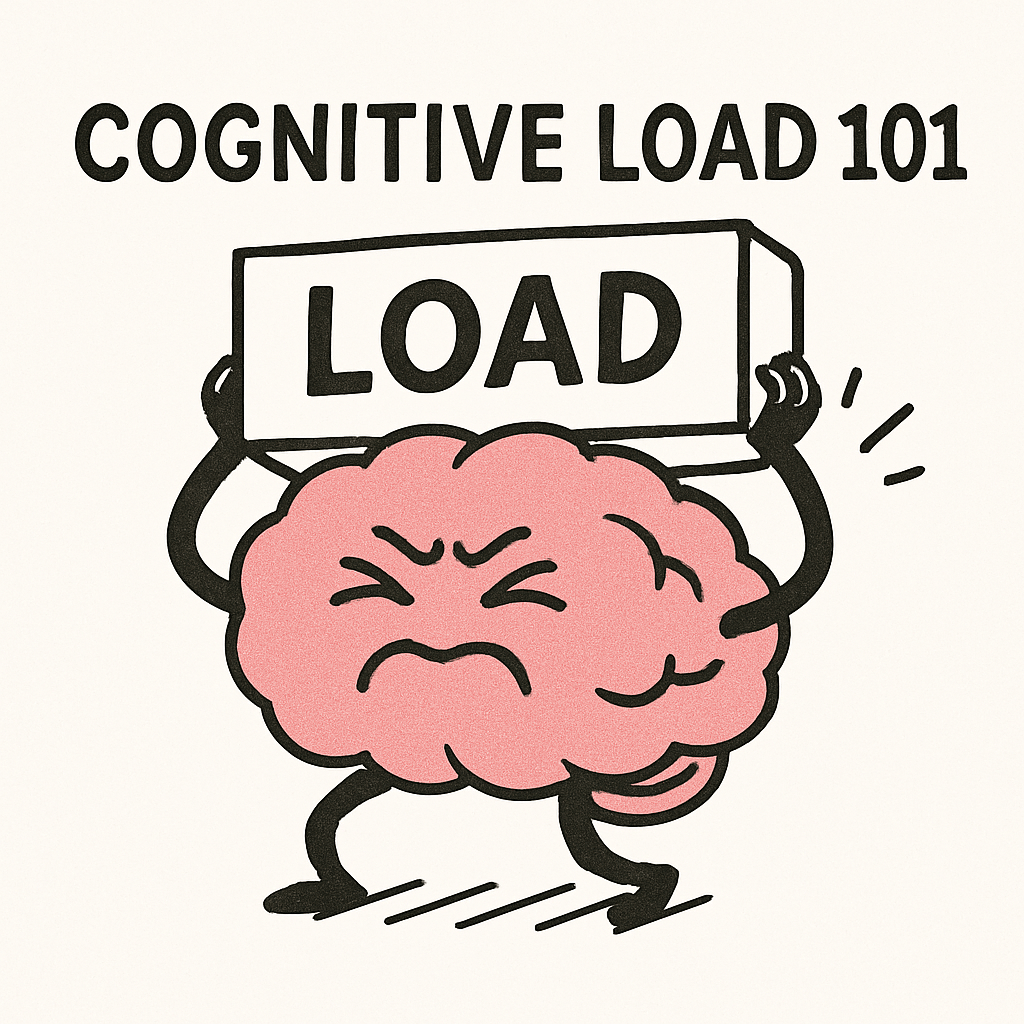
If learning feels like mental weightlifting — heavy, exhausting, and confusing — you’re not alone.
It’s not that you’re not smart. It’s that your brain is overloaded.
Welcome to the concept of cognitive load — and the good news is, once you understand it, you can hack it.
Whether you’re trying to learn AI, start a business, or finally figure out your new software stack, cognitive load is the invisible culprit behind why you’re stuck, overwhelmed, or burnt out.
Let’s break down what it is, why it matters, and how elite learners — and smart educators — work with the brain instead of against it.
What Is Cognitive Load, Really?
Cognitive load is the amount of mental effort your brain is using at any given moment.
Think of it like your brain’s “RAM” — too many tabs open, and everything slows down. Crash risk: high.
Psychologists break it into three types:
- Intrinsic Load – the natural complexity of the topic
- Extraneous Load – unnecessary confusion from bad design or explanations
- Germane Load – the good kind of load: effort that actually leads to learning
The trick isn’t to eliminate mental effort — it’s to eliminate the wasted kind.
Why ‘Hard Learning’ Isn’t Better
There’s a myth that if something is hard, it must be working.
Wrong. That’s like saying pain equals gain no matter the context — even if you’re lifting with bad form.
When you’re overloaded, your brain can’t process or retain what you’re trying to learn.
Instead of insight, you get frustration. Instead of mastery, you get mental white noise.
Here’s what high cognitive load looks like:
- Re-reading the same sentence 4 times
- Switching between 15 tabs trying to “get it”
- Watching a tutorial but forgetting everything right after
- Feeling like your brain is buffering mid-thought
Sound familiar? That’s not “challenging.” That’s cognitive overload.
The Secret Shortcut? Reduce the Load, Not the Learning
Elite learners do one thing differently:
They simplify the environment so the brain can focus on what matters.
Here’s how they hack cognitive load:
1. Use Analogies to Lower Intrinsic Load
When a concept is hard, your brain needs a mental model to hook it onto.
That’s where analogies come in.
Trying to understand neural networks? Think: “a recipe that tweaks itself each time you cook.”
Learning data pipelines? Picture: “water flowing through pipes, with filters along the way.”
The moment you connect the unknown to the known, you cut through the fog — and reduce the load.
2. Cut the Clutter (Extraneous Load)
Most people are overloaded not because the topic is hard — but because it’s explained poorly.
- Skip overcomplicated diagrams
- Break learning into small steps
- Use clean, visual explanations
- Get rid of the “tech speak” until it’s necessary
At Analogenius, we call this: Teaching with Clarity, not Complexity.
3. Build In Layers (Germane Load)
Germane load is the good kind — it’s the deep mental effort that forms real understanding.
Think of it like strength training for your brain:
- Start with the foundation (big picture understanding)
- Add layers gradually (details, nuances)
- Reinforce with examples, practice, and application
The goal isn’t to avoid thinking. It’s to spend your thinking energy where it counts.
What Happens When You Reduce Cognitive Load?
Magic.
- Learning feels lighter
- Retention skyrockets
- Application becomes second nature
- You get the satisfaction of saying: “Ohhh, I get it now.”
This is why the best teachers, coaches, and creators always seem to make things click.
They’re not dumbing it down — they’re removing what doesn’t matter so your brain can focus on what does.
TL;DR: Don’t Work Harder. Learn Smarter.
‘Hard learning’ often just means inefficient learning.
The goal isn’t to suffer your way through complexity.
It’s to create mental space so real understanding can happen.
And the way to do that?
- 🧠 Manage your cognitive load
- 🧩 Use analogies
- ✂️ Eliminate clutter
- 🧱 Build in thoughtful layers
Because your brain isn’t a machine to be maxed out.
It’s a tool to be optimized.
Want Learning That Feels Lighter — and Lasts Longer?
At Analogenius, we don’t believe in overwhelm.
We believe in brain-smart learning that sticks.
Through analogies, clarity, and cognitive shortcuts, we teach in a way your brain actually likes.
Because learning doesn’t need to be hard — just smart.
-Love and Learning, The Analogenius Team
 The Analogenius Blog
Leave a comment